- The Future of Networking
- Posts
- How to attract new job opportunities in the AI automated era
How to attract new job opportunities in the AI automated era
Part II of job hunting smarter, not harder

Nicole Vasquez
March 11, 2026
Last time you heard from me, I left you with what I consider to be the first steps for a job hunt in the AI-automated era:
1) Network mapping
2) Self-reflection
3) Identifying advocates
If you missed that newsletter, catch up here first.
Now, it’s time to talk positioning. This isn’t about revamping a resume. This is about your presence, both virtual and in real life.
A job hunt is typically an exhausting (and crowded) upstream swim.
What if instead, you could position yourself in a way that drew opportunities to you? 🧲
This is not a woo-woo, fluff concept, I promise.
I have seen it proven time and time again, that when you are seen as the person equipped to do a very specific thing, people will remember you, and opportunities will come your way. They don’t magically appear without work and a strategy—that’s where you come in.
Since I’ve tried so many AI tools for networking and personal visibility, I will say this: AI can’t 100% do this for you.
Sure, AI can help you write posts that showcase you as an expert, but you still 1) need to actually be an expert in that thing and 2) need to tell AI what to write about.
That being said, this newsletter will focus on your humanness so that you can stand out amongst the bots.
What does it take to create inbound opportunities?
In two words, it takes visibility and relevancy.
A reminder that the last newsletter left off with reaching out to your advocates, and if you’re re-engaging with people you know, you want to be able to point to some sort of reference material, and give them something to point others to.
In 2026, this often means posting online, but your credibility could also come from a physical thing such as a newsletter you write, a group that you lead, a community you’ve built, a project you’ve completed, and so on.
When we dive deep with our clients, we always take into account what format they feel most comfortable in, and if social media is not their cup of tea, we don’t advise them to lean into it for their visibility.
However, for the sake of keeping this newsletter targeted and action-oriented, we’ll keep the tactics to social media.
I'm the first to say that I am not a publicist, nor a social media marketer who's going to tell you that you need to post 3x per week, on this day at this time, etc. However…
As an executive networking expert, I know that it is vital to at least occasionally offer a “look underneath the hood” of what you do in your work, especially when you’re seeking a new role.
Whether you work at a big corporation, a middle market company, or a small startup, you can talk about your expertise in a way that's helpful to people.
Here’s the most important takeaway from this newsletter is: It is important for you to consistently talk about what you are doing, how you are solving a real issue on the job, and your unique way of solving it.
Doing that consistently provides a few things:
It provides visibility, meaning that people start to see you for “that thing you do.”
It provides credibility because it shows that you’re getting paid by a company to do “that thing you do.”
It provides relevancy, which means you get an opportunity to stay “top of mind” with people. For example, I always connect with somebody on LinkedIn when I meet them at an event, because, as someone who posts regularly, adding them to my network gives them a window into what I'm doing. Months or even years later, a person may reach out to you if they are able to remember you when their need arises.
💡 My tip to getting started sharing your work / knowledge publicly is: Use a template. Whether on a weekly or daily basis, make a note of all the things that you're doing for your current clients, for your boss, etc. Describe each of them in a similar format:
Here's what I do
Here's the problem that it solves
Here's my unique take on it
Here's the outcome
Your digital persona is crucial.
Staying visible, credible, and relevant isn’t just about posting — it’s about positioning.
It’s time for an audit of your online persona. When somebody is checking you your digital presence, are they able to see your unique expertise and get a good sense of exactly what you want to be hired for?
When being considered for a job, your digital persona should make it crystal clear that you should be hired for a particular role. It should establish that you’re the right person for the job, that you have a strong track record to support that reasoning.
I get the sense that a lot of times people update their profile to be generic or broad because they don't want to miss an opportunity, but I’m of the belief that you actually want to be very specific. In the last newsletter, the homework was to get clear on what you want. Make sure that your digital persona represents that desire.
👉 Don’t hesitate to use an AI headshot to enhance your online presence! I use one on my LinkedIn profile and in the thumbnails throughout the web archive of my newsletters. Please use your judgment…if the image doesn’t truly look like you, don’t use it!
👉 If writing posts intimidates you, it’s ok to lean on AI for ideas or caption generation. On the other hand, the giveaways of an AI-generated post are becoming more and more evident. My suggestion is to always draw on your unique expertise as your source, while using AI to polish your writing. Don't let AI change your format or tone.
👉 I’m a believer that video is a super important part of a digital presence. Don’t be afraid of video, especially as a way to communicate tone if you’re not able to in writing. I personally love Descript for video editing.
Plugging the gaps in your network map
The instructions I offered in my last newsletter will bring you to a point of clarity. Now that you know what you want to go for and have identified the gaps in your network map, it’s time to figure out how to chart a path towards the people you need to know for the roles you want to land.
Who are the people and companies that you need to engage with learn more about the roles you’re interested in, or to have the right opportunities land on your radar — or even be presented to you? And how can you spend time in rooms with those people?
Now, I know you can't just invite yourself into a room of HR directors at your ideal company. But can you look for where people from that company spend their time, or discover what interests the people who are hiring for the roles you’re seeking? Can you work your way into those rooms, or even create those rooms for yourself?
That process of discovery involves asking yourself what these people really care about, and how you can provide unique value to them. 👇
This is exactly what we do through our Networking OS. When we chart a path for our executives to meet their goals through relationships, one of the questions we ask are:
Who are the people you need to meet?
What do they care about?
How can you provide value to them that aligns with what they care about, and your expertise?
Visibility, credibility, and relevance in action

Using all I just described, let’s unpack what it took to land this hypothetical inbound opportunity.
1) “We met at one of your finance executive dinners.” That signals to me that Raven is hosting consistently hosting intentional gatherings (I say consistently because “dinners” is plural.)
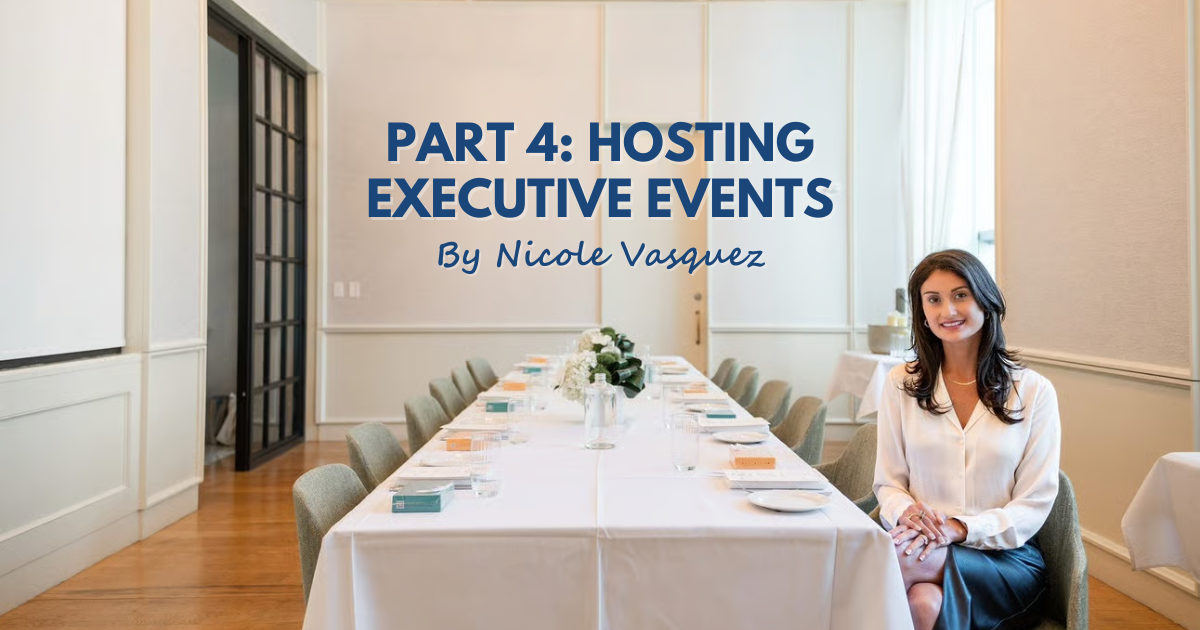
Here’s how to get started hosting your own intentional gatherings. 👇
2) “I've been enjoying your posts on how leaders in finance can leverage their skills in other roles.” This signals to me that Raven has been consistently posting, providing visibility into her expertise. She's also offering a unique perspective, such as how leaders in finance can leverage their skills in other roles. She's making public what she's doing, she's doing it consistently, and she's leaning into a unique benefit or solution that she wants to be known for.
Now, David is reaching out to her because he wants a COO that has a finance background. And because he saw that she knows how finance leaders can apply their skills to other roles, he thought of her as his next COO. That is the exact outcome you’re going after.
Proof of concept
I was catching up with a friend (let’s call him John), who got a new job as a CEO of a large technology company, and I asked him how he ended up getting that role. John said that a friend of his (we’ll call her Jane) was actually initially offered the role and didn't want it, but recommended John to the hiring committee instead!
Of course, I needed to know more about how John was able to attract this awesome opportunity.
John explained that Jane sits on what he refers to as his “personal board of advisors.”
John acknowledged that he’s always met great people at different companies throughout his career. While they work together, they talk every single day, but when one or the other moves on to another role, they don’t talk as often. In response, John has picked a handful of people from each company he's worked with and stayed in touch with them over the years. What John has done, in effect, is create a personal board of advisors. John and Jane used to work together at Google, stayed in touch, and ultimately that led to Jane referring her job offer to John.
To me, this is a perfect example of how networking and relationship management pays can pay off in the long run. If you forget your old contacts, you can miss out on opportunities like this one. People are so often focused on meeting new people that they overlook their existing network in the process. It's the people that already know you that are going to be more likely to refer you.
As part of our Networking OS, we help our clients create a system for maintaining the visibility and relevance I’ve described. We help clients identify who's already in their network through our proprietary network analysis, and identify what the outcome is that they want — new job, or otherwise. Then, we help them chart a path to how they're going to get there through their relationships. If you're an executive that's quietly looking for your next opportunity, we can put our Networking OS to work for you.
Thanks for reading, and happy job hunting. 🤝
Nicole
Did you love this newsletter? Please forward it to a friend, or have them subscribe here.
What I’ve loved recently
I often bemoan the cheap plastic toys my son gets as gifts because they break easily and thus provide no lasting value (and I feel bad throwing them away because of the waste). This article was exactly the optimistic long-term, sustainable project (and read) that I didn’t know I needed.